

What counts as valid research?
At a recent event in Newham, a community researcher shared findings from conversations with Afghan migrants about identity, belonging and journey. But instead of presenting the work through a report or slide deck, they displayed a rug.
Woven into its patterns were stories, memories and experiences gathered through the research process. It was intricate, thoughtful and deeply personal. More importantly, it communicated people’s lived realities in a way that felt immediate and accessible.

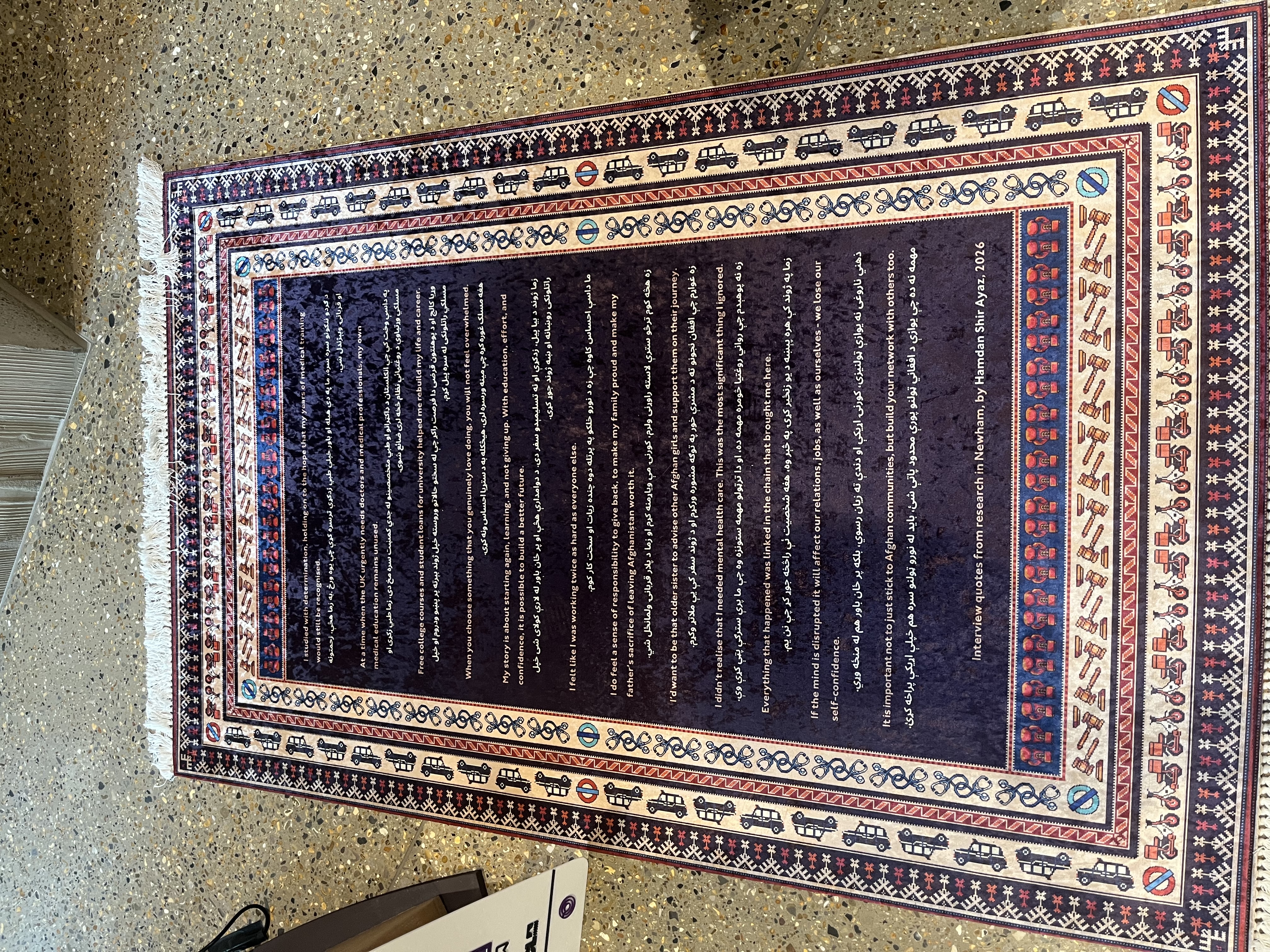
A citizen science research output: a rug
Standing in front of it, I found myself asking a simple question: what makes research valid?
For generations, we have tended to associate research with particular methods, institutions and outputs. It is often expected to emerge from universities, be captured in reports, and be communicated through academic or professional channels. These approaches generate valuable insights, but they are not the only ways of sharing research.
What are Community Research Networks?
Across the UK, a Community Research Networks (CRN) programme, funded by UK Research and Innovation, is exploring what happens when communities play a leading role in shaping research itself. Funded by UK Research and Innovation, nine networks are bringing together local residents, community organisations and academic partners to investigate issues that are relevant and important in their places.
What makes these networks distinctive is not simply who participates, but how their research is created and shared. In Newham, East London – and elsewhere – communities are experimenting with creative and participatory approaches that reflect local experiences, cultures and strengths. Research findings are being expressed through art, storytelling, music and other forms that connect more directly with people’s lives.
This challenges long-standing assumptions about expertise and validity – which, too often, are understood as being held primarily by institutions, academics, and ‘professionals’. Community-led research starts from a different premise: that people living with challenges, or tackling an issue, possess valuable knowledge about them, and can play a meaningful role in generating research and evidence about them.
This is not about replacing academic research. Rather, it is about broadening our understanding of what counts as evidence and whose research is recognised. Community researchers often bring perspectives, relationships and insights that might otherwise be overlooked. They can reach different people, uncover different forms of understanding, and present their work in ways that speak to them. Research that is shaped with communities, rather than conducted on or for them, can be more relevant, more accountable and more accessible to the people it seeks to serve.
Building long-term participation through community research
The Community Research Networks programme also highlights the importance of long-term investment. Meaningful participation cannot be built overnight. The programme’s five-year funding model gives networks the opportunity to build relationships, develop governance structures and test new approaches over time.
While community-led research is sometimes dismissed as small-scale, its significance extends far beyond individual neighbourhoods. Across places as diverse as Newham, Moray, the Isles of Scilly, and East Marsh, local community research networks are generating insights not only into the issues affecting them, but also into how systems work, where they fail, and how they might change. Together, these networks offer an opportunity to connect local research to national conversations.
Expanding what counts as evidence
The rug in Newham reminded me that research is not defined by the format in which it is presented. Its value is in whether it helps us understand the world more fully and whether the people most affected by an issue have a meaningful role in shaping that understanding.
There is no single right way to generate or communicate research. But if we are serious about addressing complex social challenges, we should be open to forms and approaches that expand participation, challenge assumptions about expertise, and bring us closer to people’s lived realities.
The question is not whether community research is valid. It is whether we are ready to recognise and value it on a par with traditional approaches.
Methods and measurement Peer research Co-production community research Lived Experience participation Research Methods social innovation Posted on: 7 July 2026 Authors: Nairat Ali,